Frame Availability and the Timing of Generative AI Use in Early-Stage Venture Decision-Making
Supervisor: Dr Pelin Demirel Liu
Pre-seed founders make consequential decisions under uncertainty and increasingly turn to generative AI for support. This study examines when AI enters relative to frame availability, that is whether the founder already holds a working interpretation of the decision and criteria for judging responses to it. Twenty-nine semi-structured interviews with pre-seed technology founders in the US and UK found that frame availability varied within founders across decision domains. Where a frame was available before AI entered, founders assessed its output against their own understanding. Where it was not, AI could become involved in shaping how the decision was understood. Founders regulated their reliance through verification, human input and domain boundaries, but often only after costly reality checks. The resulting cognitive-forcing intervention withholds substantive advice until founders articulate their own understanding of the decision. Five founders evaluated the design for feasibility and acceptability.
1Introduction
Early-stage venture decisions are made under Knightian uncertainty, where outcomes cannot be reliably predicted and the relevant information may not yet exist. Sensemaking research explains how people build workable interpretations of ambiguous situations in order to keep acting, and cognitive frames are the knowledge structures through which they organise and interpret what they encounter.
Generative AI introduces a new source of input into that process with almost no practical or interpersonal friction. Advice-taking research shows reliance rises with task difficulty and falls with domain expertise, and human-AI research shows that the order of human judgement and AI advice affects reliance. That work says little about what happens when AI enters while the decision-maker is still making sense of the problem.
How does the timing of generative AI entry relative to cognitive frame availability shape early-stage venture decision-making?
2Method
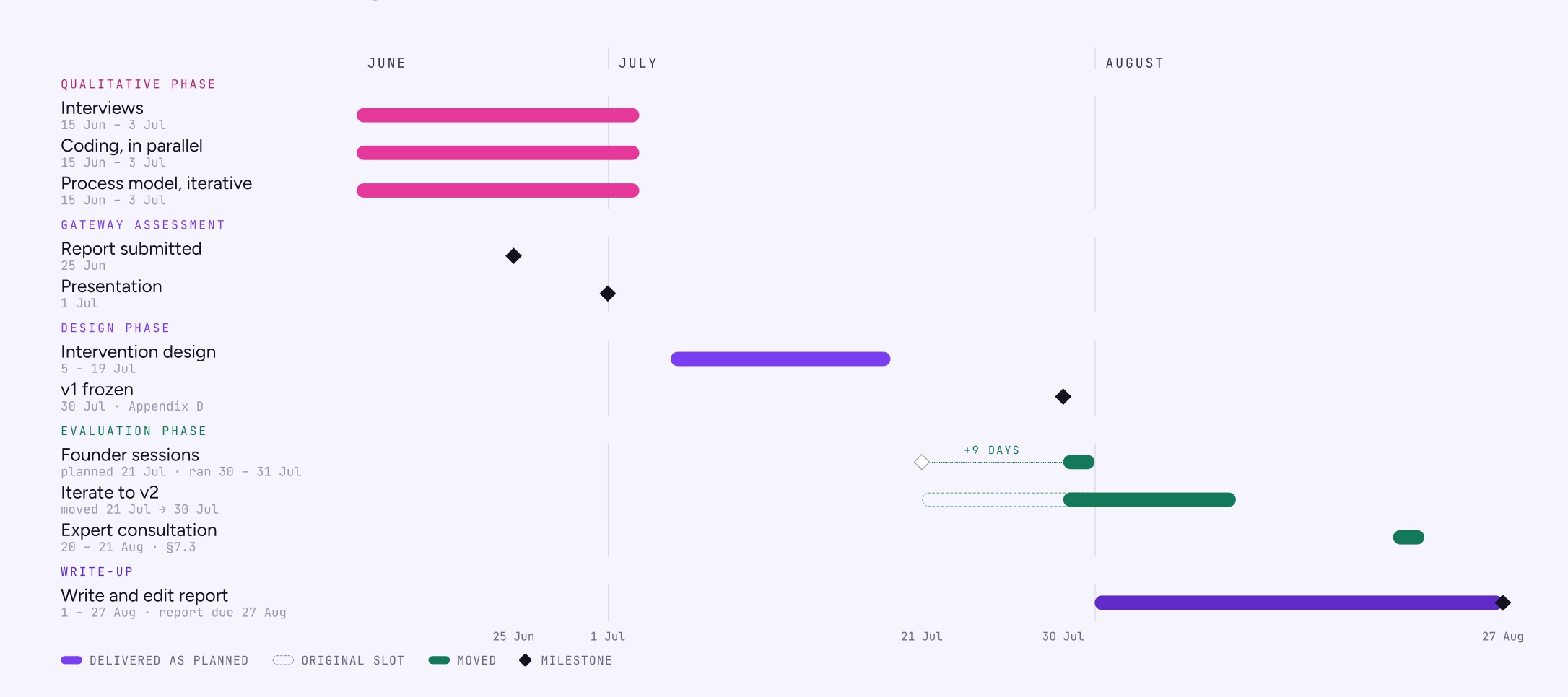
Twenty-nine semi-structured interviews of 35 to 45 minutes with pre-seed technology founders in the US and UK, recruited by criterion-based purposive sampling through founder networks, LinkedIn and referrals. Accounts were retrospective and episode-level, following the logic of the critical incident technique, so the unit of analysis is the decision episode rather than the founder.
Analysis followed the Gioia methodology, which provides an audit trail from informant terms to theoretical dimensions. A frame was coded as available when the relationship between the focal problem and an appropriate response was evident before substantive AI input, and not yet available otherwise.
3Findings
3.1Frame availability varies within founders
For nine founders, frame availability differed across decision domains. One was confident in her market and had no frame for an unfamiliar codebase. Another had a frame for code architecture but not for pricing. Frame availability is therefore not well described as a stable characteristic of the founder, which supports treating the decision episode as the unit of analysis.
3.2Entry timing separates two pathways
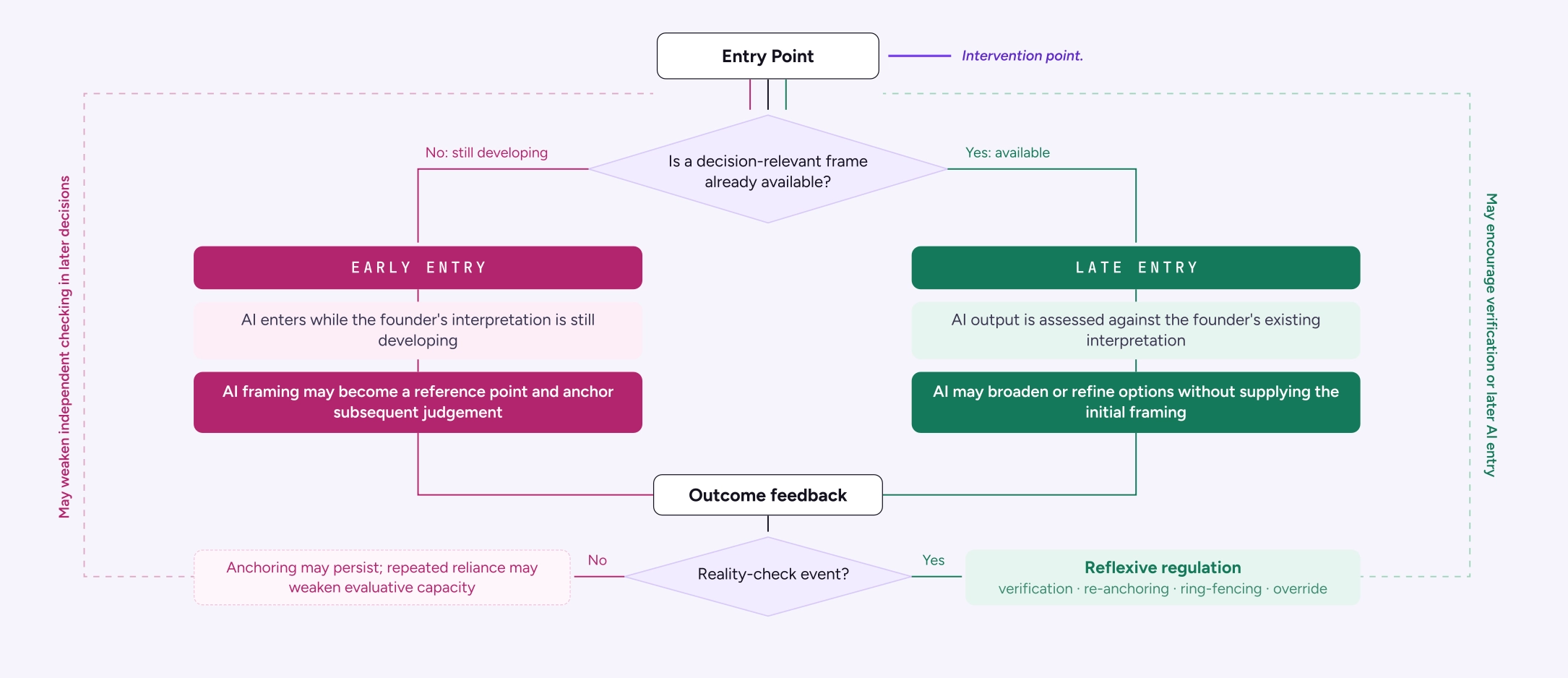
Where a frame was available before AI entered, founders assessed output against their existing interpretation. Where none was available, the model could supply that interpretation, with sycophancy and surface validation reinforcing anchoring. The risk is not that AI contributes while sensemaking is ongoing, but that it may become the first salient account of the decision.
3.3Regulation is real, but reactive
Regulation is the largest dimension in the codebook. Founders verify in proportion to stakes, re-anchor on human signal, ring-fence domains and override the model where they hold a frame. Regulation typically follows a reality check, such as a lost deal or investor pushback, so the correction comes from the market rather than from the founder’s metacognition. Where feedback is slow or decisions are irreversible, anchoring can go uncorrected.
4Intervention design
4.1Behavioural diagnosis
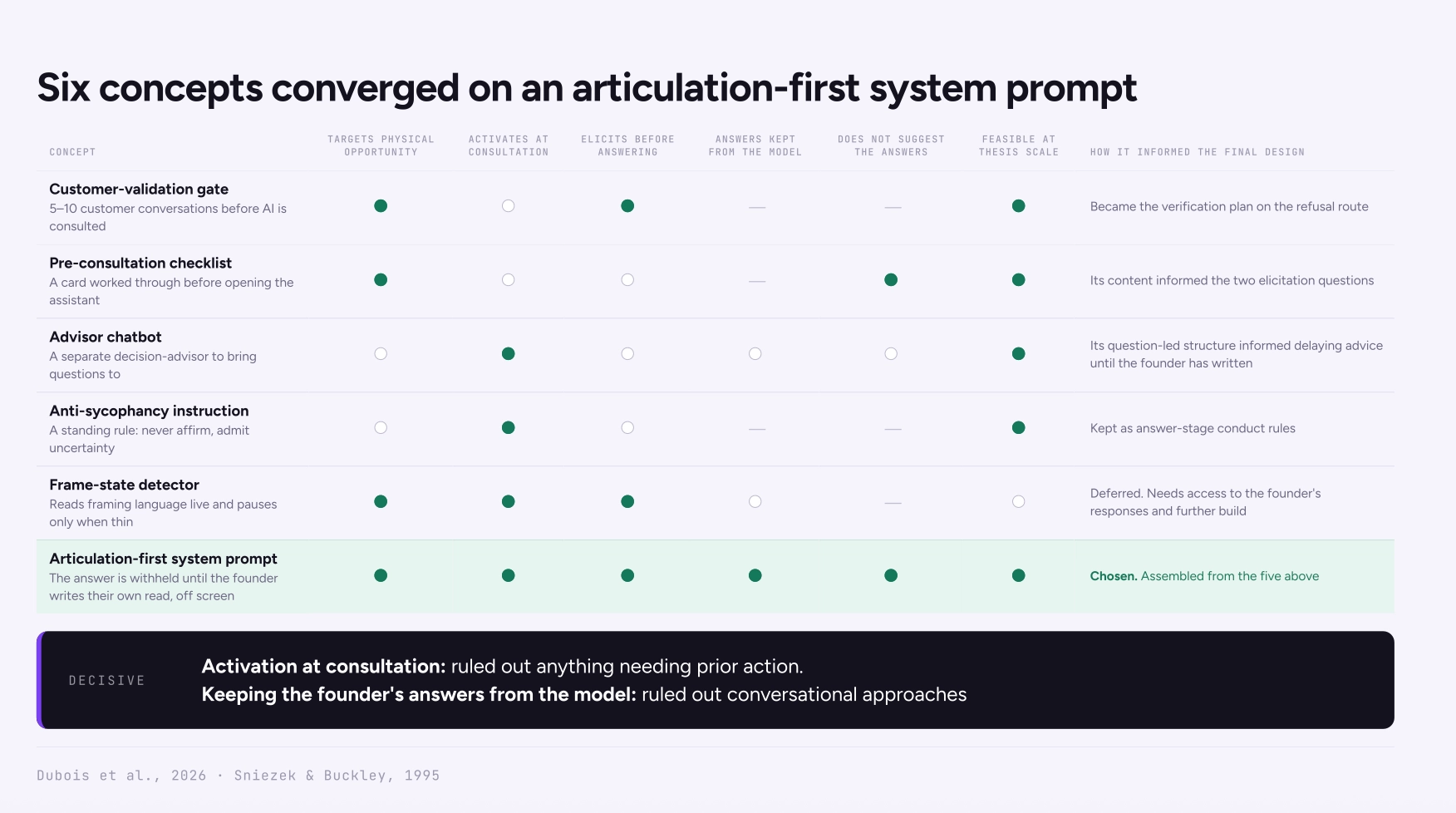
COM-B identified physical opportunity as the primary barrier, since consultation is immediate and carries no built-in pause, and automatic motivation as secondary. PRIME clarified why reflective intentions to regulate did not translate into behaviour at the point of consultation. The Behaviour Change Wheel pointed to environmental restructuring as the primary intervention function, with enablement retained for founders unable to proceed. Restriction was rejected, since the aim was not to prevent AI use.
4.2Concept selection
Six concepts were assessed against six design criteria. The final concept combined elements of several alternatives.
4.3The intervention
The intervention is delivered as custom instructions, stored with the account and prepended on every turn, so it is installed once rather than invoked per decision. On a consequential or hard-to-reverse judgement request, the model withholds its answer and asks two questions adapted from the diagnostic and prognostic aspects of cognitive-frame research: what decision are you making, and what would have to happen for you to call it the right one.
The founder answers outside the chat, which keeps their position out of the model’s context and reduces sycophancy risk. The pause is limited to a single turn, fires once per episode, avoids alert styling, and never suggests the founder’s answers. Because custom instructions are conditioning text rather than executable code, compliance is measured rather than assumed.
5Feasibility evaluation
Five founders from the qualitative sample installed v1 and used it on a live, unresolved decision. The pause fired unprompted on the first qualifying question in all five sessions with no false positives, although the protocol deliberately elicited qualifying decisions, so specificity was weakly tested. All five completed installation, two only after moving to a desktop browser and a personal account. No founder used the refusal route, which therefore remains untested.
The evaluation did not suggest weakening the mechanism: both trigger conditions, the two questions and both refusal routes carried over unchanged. Following the MRC framework, the progression decision is to repeat with refinement.
6Contribution and limitations
The study contributes to sensemaking research by showing that generative AI may either encounter an existing cognitive frame or become involved while one is still taking shape, and it identifies entry timing as a point for intervention. It also suggests prior knowledge is better considered at the decision-domain level than as a characteristic of the founder.
The qualitative findings are limited by single-researcher coding, retrospective accounts and a sample of active AI users only. The evaluation used five founders, one model and a single exposure, with no comparison condition and no ground-truth measure of decision quality, so it establishes usability and tolerance rather than effectiveness. All five evaluation participants had taken part in the qualitative phase, creating a risk of demand characteristics.
7Critical reflection
I let frame availability sharpen late, during analysis. Next time the theoretical construct constrains interpretation from the outset rather than validating it afterwards.
It was important to start with a large scope, however, defining the scope earlier would have allowed me to trace more decision episodes that were specific to conversational use.
COM-B, PRIME and the BCW made explicit what the findings implied. The design still needed judgement about timing, independence and acceptable friction. I underestimated that at the start.
I am a pre-seed founder. I now form an independent view before consulting AI on consequential decisions, and I measure the mechanism rather than trust that it worked.